 Add to Chrome
 Add to Firefox
 Add to Edge
A Comprehensive Analysis of Tokenization and Self-Supervised Learning in End-to-End Automatic Speech Recognition applied on French Language
May 05, 2026
The performance of end-to-end automatic speech recognition (ASR) systems enables their increasing integration into numerous applications. While there are various benefits to such speech-to-text systems, the choice of hyperparameters and models plays a crucial role in their performance. Typically, these choices are determined by considering only the character (CER) and/or word error rate (WER) metrics. However, it has been shown in several studies that these metrics are largely incomplete and fail to adequately describe the downstream application of automatic transcripts. In this paper, we conduct a qualitative study on the French language that investigates the impact of subword tokenization algorithms and self-supervised learning models from different linguistic and acoustic perspectives, using a comprehensive set of evaluation metrics.

A Paradigm for Interpreting Metrics and Identifying Critical Errors in Automatic Speech Recognition
May 05, 2026The most commonly used metrics for evaluating automatic speech transcriptions, namely Word Error Rate (WER) and Character Error Rate (CER), have been heavily criticized for their poor correlation to human perception and their inability to take into account linguistic and semantic information. While metric-based embeddings, seeking to approximate human perception, have been proposed, their scores remain difficult to interpret, unlike WER and CER. In this article, we overcome this problem by proposing a paradigm that consists in incorporating a chosen metric into it in order to obtain an equivalent of the error rate: a Minimum Edit Distance (minED). This approach parallels transcription errors with their human perception, also allowing an original study of the severity of these errors from a human perspective.
Evaluation of Automatic Speech Recognition Using Generative Large Language Models
Apr 23, 2026Automatic Speech Recognition (ASR) is traditionally evaluated using Word Error Rate (WER), a metric that is insensitive to meaning. Embedding-based semantic metrics are better correlated with human perception, but decoder-based Large Language Models (LLMs) remain underexplored for this task. This paper evaluates their relevance through three approaches: (1) selecting the best hypothesis between two candidates, (2) computing semantic distance using generative embeddings, and (3) qualitative classification of errors. On the HATS dataset, the best LLMs achieve 92--94\% agreement with human annotators for hypothesis selection, compared to 63\% for WER, also outperforming semantic metrics. Embeddings from decoder-based LLMs show performance comparable to encoder models. Finally, LLMs offer a promising direction for interpretable and semantic ASR evaluation.
Enhancing Multi-Corpus Training in SSL-Based Anti-Spoofing Models: Domain-Invariant Feature Extraction
Mar 19, 2026The performance of speech spoofing detection often varies across different training and evaluation corpora. Leveraging multiple corpora typically enhances robustness and performance in fields like speaker recognition and speech recognition. However, our spoofing detection experiments show that multi-corpus training does not consistently improve performance and may even degrade it. We hypothesize that dataset-specific biases impair generalization, leading to performance instability. To address this, we propose an Invariant Domain Feature Extraction (IDFE) framework, employing multi-task learning and a gradient reversal layer to minimize corpus-specific information in learned embeddings. The IDFE framework reduces the average equal error rate by 20% compared to the baseline, assessed across four varied datasets.
Text-Speech Language Models with Improved Cross-Modal Transfer by Aligning Abstraction Levels
Mar 08, 2025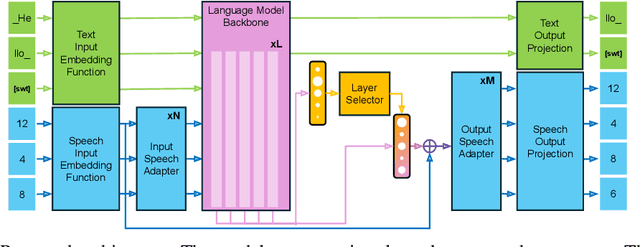
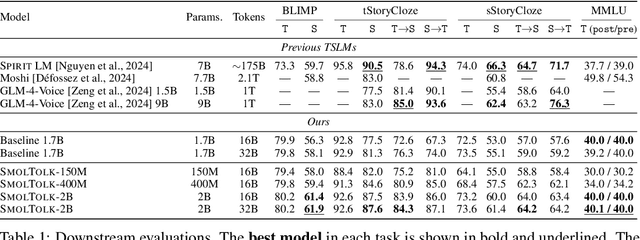
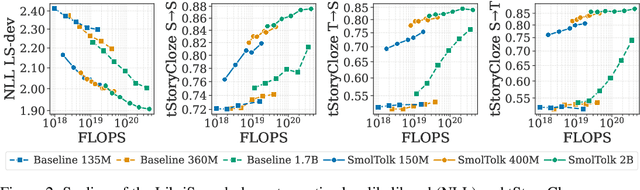
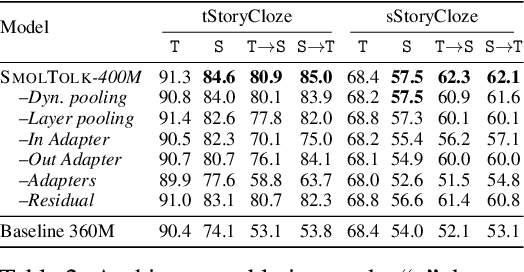
Text-Speech Language Models (TSLMs) -- language models trained to jointly process and generate text and speech -- aim to enable cross-modal knowledge transfer to overcome the scaling limitations of unimodal speech LMs. The predominant approach to TSLM training expands the vocabulary of a pre-trained text LM by appending new embeddings and linear projections for speech, followed by fine-tuning on speech data. We hypothesize that this method limits cross-modal transfer by neglecting feature compositionality, preventing text-learned functions from being fully leveraged at appropriate abstraction levels. To address this, we propose augmenting vocabulary expansion with modules that better align abstraction levels across layers. Our models, \textsc{SmolTolk}, rival or surpass state-of-the-art TSLMs trained with orders of magnitude more compute. Representation analyses and improved multimodal performance suggest our method enhances cross-modal transfer.
A Benchmark of French ASR Systems Based on Error Severity
Jan 18, 2025

Automatic Speech Recognition (ASR) transcription errors are commonly assessed using metrics that compare them with a reference transcription, such as Word Error Rate (WER), which measures spelling deviations from the reference, or semantic score-based metrics. However, these approaches often overlook what is understandable to humans when interpreting transcription errors. To address this limitation, a new evaluation is proposed that categorizes errors into four levels of severity, further divided into subtypes, based on objective linguistic criteria, contextual patterns, and the use of content words as the unit of analysis. This metric is applied to a benchmark of 10 state-of-the-art ASR systems on French language, encompassing both HMM-based and end-to-end models. Our findings reveal the strengths and weaknesses of each system, identifying those that provide the most comfortable reading experience for users.
MSP-Podcast SER Challenge 2024: L'antenne du Ventoux Multimodal Self-Supervised Learning for Speech Emotion Recognition
Jul 08, 2024


In this work, we detail our submission to the 2024 edition of the MSP-Podcast Speech Emotion Recognition (SER) Challenge. This challenge is divided into two distinct tasks: Categorical Emotion Recognition and Emotional Attribute Prediction. We concentrated our efforts on Task 1, which involves the categorical classification of eight emotional states using data from the MSP-Podcast dataset. Our approach employs an ensemble of models, each trained independently and then fused at the score level using a Support Vector Machine (SVM) classifier. The models were trained using various strategies, including Self-Supervised Learning (SSL) fine-tuning across different modalities: speech alone, text alone, and a combined speech and text approach. This joint training methodology aims to enhance the system's ability to accurately classify emotional states. This joint training methodology aims to enhance the system's ability to accurately classify emotional states. Thus, the system obtained F1-macro of 0.35\% on development set.
Zero-Shot End-To-End Spoken Question Answering In Medical Domain
Jun 09, 2024In the rapidly evolving landscape of spoken question-answering (SQA), the integration of large language models (LLMs) has emerged as a transformative development. Conventional approaches often entail the use of separate models for question audio transcription and answer selection, resulting in significant resource utilization and error accumulation. To tackle these challenges, we explore the effectiveness of end-to-end (E2E) methodologies for SQA in the medical domain. Our study introduces a novel zero-shot SQA approach, compared to traditional cascade systems. Through a comprehensive evaluation conducted on a new open benchmark of 8 medical tasks and 48 hours of synthetic audio, we demonstrate that our approach requires up to 14.7 times fewer resources than a combined 1.3B parameters LLM with a 1.55B parameters ASR model while improving average accuracy by 0.5\%. These findings underscore the potential of E2E methodologies for SQA in resource-constrained contexts.
* Accepted to INTERSPEECH 2024
Asymmetric and trial-dependent modeling: the contribution of LIA to SdSV Challenge Task 2
Mar 28, 2024


The SdSv challenge Task 2 provided an opportunity to assess efficiency and robustness of modern text-independent speaker verification systems. But it also made it possible to test new approaches, capable of taking into account the main issues of this challenge (duration, language, ...). This paper describes the contributions of our laboratory to the speaker recognition field. These contributions highlight two other challenges in addition to short-duration and language: the mismatch between enrollment and test data and the one between subsets of the evaluation trial dataset. The proposed approaches experimentally show their relevance and efficiency on the SdSv evaluation, and could be of interest in many real-life applications.
Probing the Information Encoded in Neural-based Acoustic Models of Automatic Speech Recognition Systems
Feb 29, 2024

Deep learning architectures have made significant progress in terms of performance in many research areas. The automatic speech recognition (ASR) field has thus benefited from these scientific and technological advances, particularly for acoustic modeling, now integrating deep neural network architectures. However, these performance gains have translated into increased complexity regarding the information learned and conveyed through these black-box architectures. Following many researches in neural networks interpretability, we propose in this article a protocol that aims to determine which and where information is located in an ASR acoustic model (AM). To do so, we propose to evaluate AM performance on a determined set of tasks using intermediate representations (here, at different layer levels). Regarding the performance variation and targeted tasks, we can emit hypothesis about which information is enhanced or perturbed at different architecture steps. Experiments are performed on both speaker verification, acoustic environment classification, gender classification, tempo-distortion detection systems and speech sentiment/emotion identification. Analysis showed that neural-based AMs hold heterogeneous information that seems surprisingly uncorrelated with phoneme recognition, such as emotion, sentiment or speaker identity. The low-level hidden layers globally appears useful for the structuring of information while the upper ones would tend to delete useless information for phoneme recognition.